
Smyrna Tree Removal has handled land clearing across Middle Tennessee for more than twenty years, from single overgrown residential lots to builder pads and acreage reclamation in Smyrna, TN and serving surrounding cities including La Vergne, Nolensville, Murfreesboro, Brentwood and Mount Juliet. Clearing is the service where getting the regulatory question wrong is most expensive, so we settle that first and quote second.
This service area crosses six counties and fifteen cities, and they do not share an answer on tree removal, land disturbance or what has to be preserved. A lot that can be cleared to the fence line in one town needs an approved plan in the next, and a builder who assumes otherwise finds out at inspection. We read the ordinance that governs the address rather than the one we saw last week.
On the ground the choices are narrower and more practical: what gets mulched in place, what leaves as logs, what stays standing and how the soil is protected while the work happens. The soils here are shallow over limestone and they compact quickly, so how a site is worked matters as much as what comes off it.
What Land Clearing Actually Covers
Clearing to Bare Ground
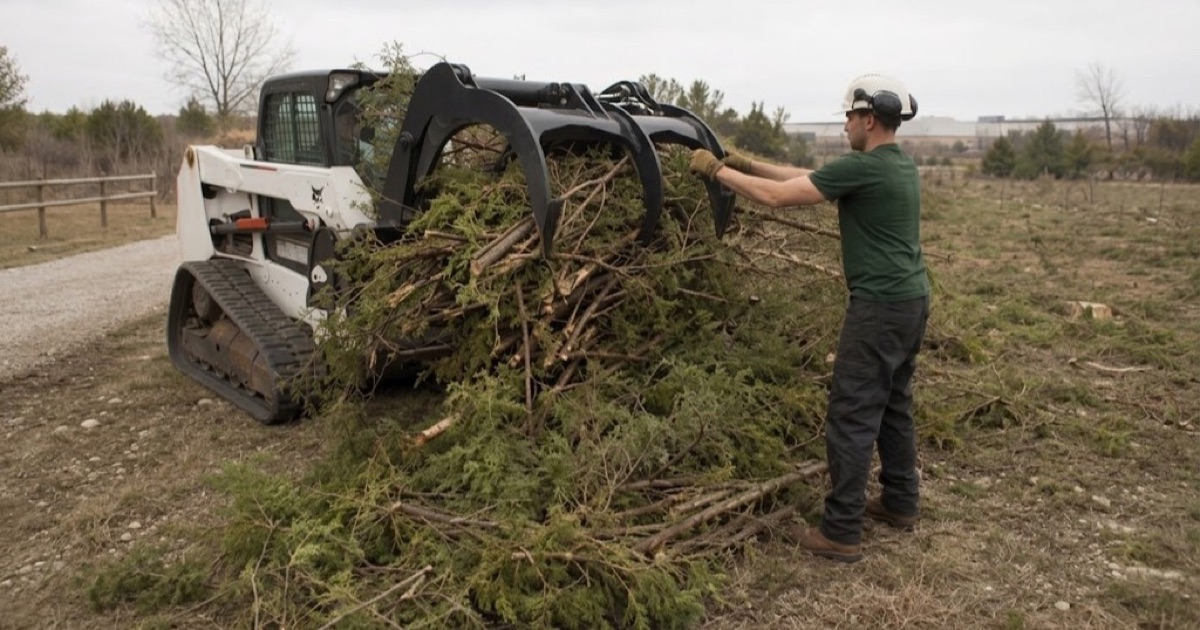
Full clearing takes everything off a defined area: standing trees, understory, stumps where the finished use needs them out, and the debris. This is what a pad, a driveway alignment or a utility corridor requires. It is the most expensive version of the work and the one most often bought by default when a lighter option would have done the job.
Selective Clearing With Trees Retained
Most residential clearing here is selective. Specimen trees stay, the understory and volunteer growth go, and the retained trees are marked and protected before a machine starts. The result reads as a mature property rather than a cleared one, and on a regulated lot existing healthy trees can carry credit toward whatever the landscape requirements ask for later.
Underbrush, Fence Lines and Reclaimed Edges
A great deal of what owners want is not clearing at all but reclamation: a fence line swallowed by privet and honeysuckle, a creek edge gone impassable, a rear boundary that has crept twenty feet into the yard. That work is quick with the right machine, it does not disturb soil the way full clearing does, and it rarely triggers anything regulatory.
Forestry Mulching Against Cut and Haul
How the Mulcher Handles Material
A forestry mulcher takes standing stems and understory down and reduces them where they stand, leaving shredded wood across the surface. Nothing is piled, loaded or hauled, which removes the largest variable cost from the job. It suits stem sizes up to what the head is rated for; anything beyond that comes down conventionally and is chipped or cut into rounds.
When Mulching in Place Is the Better Buy
Mulching wins where the ground is staying as ground: pasture edges, hunting lanes, buffers, easements, and any slope where exposed soil would start moving in the first hard rain. The mat holds the surface, suppresses regrowth for a season and costs nothing to dispose of, which on a large area is most of the difference in the quote.
When the Material Has to Leave
It has to leave when the ground under it is being graded, when a slab or footing is going in, when the mat would sit against a structure, or when the owner simply wants clean dirt. At that point disposal is a real line item and it is priced against the specific gate that serves the county the site is in, because the rates around here are not interchangeable.
Permits, Plans and Protected Trees
Land Disturbance and Grading Permits
Disturbing ground above the state’s threshold brings stormwater requirements into a job whatever the city thinks about trees, and several cities here layer their own grading or land disturbance permit on top. Franklin ties removal on a regulated site to an approved plan or permit, and Thompson’s Station requires a permit before any disturbance of existing trees. We check which applies before mobilizing.
Tree Protection Zones That Are Actually Respected
Where a plan requires trees to be saved, the protection zone is a line on a drawing until somebody fences it. Fencing goes up before the first machine arrives, stays up through the job, and keeps traffic, spoil and material storage off the root plate. Trees are lost to compaction inside their own protection zone far more often than they are lost to a saw.
Stormwater and the Limits of Disturbance
A clearing plan usually carries a marked limit of disturbance and a drainage feature it is meant to protect, and staying inside those lines is the difference between an inspection that passes and one that stops the site. We work to the marked limits, keep material out of the protected drainage, and leave the erosion controls the plan calls for standing when we go.
Site Preparation for Builders
Pads, Stump Holes and Compaction
On a site heading for construction, sequencing matters more than speed. Stumps come out ahead of grading and the holes get backfilled and compacted in lifts, because a stump hole loosely filled becomes a soft spot under a slab and shows up as settlement long after everyone has left. We coordinate that directly with the grading contractor.
Access Roads, Laydown and Turning Room
A cleared site that nobody can work is not finished. Access alignment, a laydown area that drains, and turning room for the trucks that follow are all decided during clearing or not at all. Getting them right costs nothing extra at the time and saves the second mobilization that otherwise arrives once the framing crew cannot get in.
Protecting What the Plan Requires You to Keep
A site with required plantings and preserved specimens has a landscape obligation waiting at the end of it, and Smyrna’s own regulations give substantial credit for existing healthy trees of size where they are surrounded by enough landscape area. Losing those trees during clearing converts a credit into a planting bill, which is a straightforward reason to fence them properly.
Acreage, Pasture and Rural Work
Cedar Encroachment and Pasture Reclamation
Eastern redcedar colonizes open ground across the Nashville Basin quickly, and a pasture left alone for a decade comes back as closed cedar. Mulching handles that efficiently and leaves a mat that protects thin soil while grass re-establishes. Where the glade character is worth keeping, we clear selectively rather than uniformly and say why on the estimate.
Tree of Heaven and Persistent Regrowth
Tree of heaven resprouts aggressively from roots after cutting, and clearing it mechanically without a plan for the regrowth guarantees a return visit. It is also the preferred host of the spotted lanternfly, which the state has confirmed in several counties adjoining this one. We flag it during the walk-through and set expectations about follow-up rather than pretending one pass ends it.
Working Around Wet Ground
Thin soils over limestone dry through summer and autumn and saturate through winter and spring, so the calendar has a real effect on what a site looks like afterward. Heavy work on saturated ground leaves rutting and compaction that outlast the clearing itself. Where the schedule allows, we time acreage work to the dry side of the year and say so instead of quietly rutting a field.
- 20+ Years in Middle Tennessee
- Free Written Estimates
- ANSI A300 Pruning, No Topping