
Smyrna Tree Removal has been doing stump grinding across Middle Tennessee for more than twenty years, on residential lawns, fence lines and builder pads in Smyrna, TN and serving surrounding cities including La Vergne, Nolensville, Murfreesboro, Brentwood and Mount Juliet. It is the part of a tree job that gets quoted casually most often, and it is the part where the ground under this region genuinely changes the answer.
A tracked stump grinder is rated to cut a certain distance below grade, and on much of this service area it will find limestone before it finds the bottom of the root system. That is not a machine problem and not something more horsepower fixes. It means an honest quote here describes what the wheel can reach on your particular lot, rather than repeating a depth figure copied from a national page.
We grind stumps we felled ourselves and stumps somebody left behind years ago, we handle the grindings the way you want them handled, and we say in writing which of the trunk rounds, the stump, the grindings and the chips are leaving the property. Nothing about the finish is left as an assumption.
Grinding a Stump Against Pulling It Out Whole
What the Grinder Actually Removes
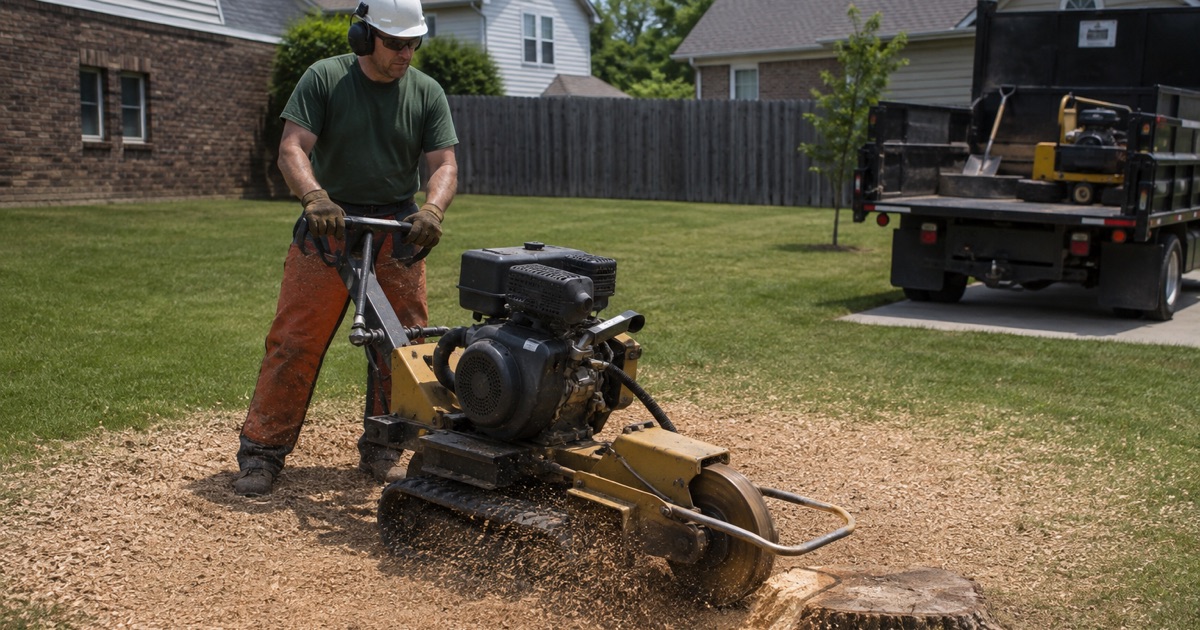
A grinder reduces the visible stump and the top of the root collar to chips, working the wheel across the face in passes until the remains sit below the surrounding grade. The lateral roots stay in the ground and decay over several years. For turf, a fence line, a flower bed or a patio slab, that is a complete answer and it is the cheaper one by a wide margin.
When Excavating the Whole Stump Is the Right Call
Some jobs need the volume genuinely empty: a footing, a pool shell, a retaining wall, a utility trench following the old root run, or a replacement tree going into the identical spot. Those call for an excavator, a much larger hole and a disposal cost for the root ball. We quote extraction only where the finished use requires it, because it is disruptive work and it is rarely necessary.
Comparing Cost, Mess and Recovery
Grinding leaves a mound of chips and a lawn that recovers in a season. Extraction leaves a crater the width of the root plate, a machine track across the yard, and soil that will settle for a year unless it is compacted in lifts. The price gap is wide enough that we walk owners through both before they choose, rather than defaulting to whichever is easier to sell.
How Deep the Wheel Reaches on This Ground
Rated Depth Against Depth to Bedrock
A machine rated to cut 12 to 16 inches below grade is well matched to deep soil. The Barfield series that is type-located in Rutherford County runs 8 to 20 inches to limestone bedrock, and the Gladeville series about 3 to 12 inches, so on those soils the wheel meets rock partway down. The practical result is a stump ground flush and slightly below, not a deep excavation, and we tell you that up front.
Chert Volume, and Why It Is a Separate Problem
Depth to rock and chert content are two different ways for a stump job to go long, and treating them as one is how estimates come apart. A shallow soil stops the wheel early. A deep soil carrying heavy chert fragments lets the wheel keep running while it grinds through gravel the whole way, which wears teeth and adds time. On the Highland Rim side of this area the second one is what we plan around.
Why We Will Not Promise a Depth Sight Unseen
Any company can quote a number over the phone, and on this ground the number is a guess. We look at the stump, the soil around it and whatever exposed rock the lot already shows before committing to a finish level. If the answer is that we can get you three inches below grade and no more, you hear it at the estimate rather than after the invoice.
The Grindings, the Hole and the Finished Patch
Backfill, Topsoil and Seed
Where the patch has to grow grass this season, the grindings come out and clean topsoil goes in, mounded slightly because the fill will settle. Seed or sod then behaves like the rest of the lawn. Skipping that step is the usual reason a ground stump shows as a dead circle a year later, since chips hold moisture and starve turf of nitrogen while they break down.
Leaving the Grindings on Site
Plenty of owners want the chips, and they are genuinely useful spread as mulch on beds well away from any trunk. Left over the hole they settle into a shallow dish that can be topped up later. This is the free option, it is fine for a back corner or a fence line, and it is a poor choice in the middle of a front lawn.
Replanting in the Same Position
A new tree set into ground stump material fails slowly and confusingly, which is worse than failing fast. If a replacement is going in the same spot we take the grindings out, bring in soil, and set the root flare visible at the finished grade. Offsetting the new planting a few feet away is often the better answer and costs nothing to do.
Access, Utilities and What Is Under the Turf
Gate Width and Tracked Machines
Most back-yard stumps are reached with compact tracked equipment sized to fit a standard subdivision gate, and tracks spread the weight so the lawn takes far less damage than a wheeled machine leaves. We measure the narrowest point on the route at the estimate, because discovering a 34-inch gate on the morning of the work costs you a day.
Locates Before the Wheel Turns
Utility locates go in through Tennessee One Call and we honor the notice period, no exceptions. A grinding wheel takes out irrigation lines, low-voltage lighting, invisible fence wire and gas services with equal indifference, and the private lines a public locate does not cover are exactly the ones an owner can point at in thirty seconds.
Fence Lines, Walls and Septic Fields
A stump against a fence post, beside a retaining wall or over a septic field limits how the machine can be positioned and sometimes limits how far down it goes. Hand digging around the obstruction, grinding from one side only, or leaving a deliberate margin are all normal answers. What is not normal is finding out afterward, so we ask about the field lines before quoting.
Stumps on Commercial and Builder Sites
Lot Clearing and Pad Preparation
On a site being prepared for construction the stumps come out ahead of grading, and the sequencing matters more than the grinding does. We coordinate with the grading contractor so stump holes are backfilled and compacted before the pad goes in, rather than leaving soft spots that show up as settlement under a slab later.
Parking Lots, Islands and Right-of-Way Work
Commercial stumps usually sit in a landscape island with curb on three sides and a drive aisle on the fourth. Those get ground with the traffic pattern planned in advance and the debris contained, because chips across a lot are a liability and a complaint. Work is scheduled around the tenant’s hours where the site is open to the public.
Volume Work and Documented Disposal
Property managers and builders generally need a paper trail as much as they need the stumps gone. We itemize by stump with the measured diameter, and the disposal is priced against the gate that serves the county the site is in, since the rates in this service area are not uniform and averaging them across a portfolio is how a budget quietly goes wrong.
- 20+ Years in Middle Tennessee
- Free Written Estimates
- ANSI A300 Pruning, No Topping