
Smyrna Tree Removal plants and transplants trees across Middle Tennessee, and after more than twenty years of taking them down we have a fairly unsentimental view of why the replacements fail. It is almost never the species being exotic or the season being unkind. It is planting depth, soil volume and the first two summers.
The ground around Smyrna, TN is the reason planting deserves more thought here than it gets. Soils on this side of the basin form on clayey residuum weathered from limestone and are shallow, with depth to bedrock measured in inches rather than feet on the thinner series. A tree planted here has less soil to work with than the nursery tag assumes, so choosing something that belongs on that ground is worth more than any amendment you can buy.
We plant for owners replacing a removal, for HOAs and property managers meeting a landscape obligation, and for builders satisfying a plan. In each case the same three things decide the outcome, and none of them is the price of the tree.
Choosing a Species for This Ground
What Grows Natively on the Basin Floor
The woodland system that covers this area is dominated by post oak, chinkapin oak and eastern redcedar, with redbud, winged elm and blue ash among the associated woody plants, and scarlet oak, white ash, Osage orange, honey locust and hackberry recorded alongside them. That is not a nostalgia list. It is a list of species that already tolerate thin soil over limestone and a summer that dries out.
Species Worth Thinking Twice About
Callery pear is planted everywhere in these subdivisions and splits on schedule because of how it builds its unions. Leyland cypress goes in as a fast screen at spacing that guarantees a bare, shaded interior within a decade. Silver maple grows quickly and surrenders limbs to ice. None of them is forbidden, and all of them are decisions worth making deliberately rather than by default.
Replacement Plantings and Landscape Requirements
On regulated sites the tree is not only landscaping, it is compliance. Smyrna’s regulations set minimum standards for required deciduous trees, including an average mature crown spread over 15 feet, a clear trunk over five feet where visibility matters, and a minimum overall height, and they require dead required plantings to be replaced within a year or by the next planting period. Some nearby towns go further and require replacement measured caliper for caliper.
Planting It So It Lives
Root Flare at Grade, Not Below It
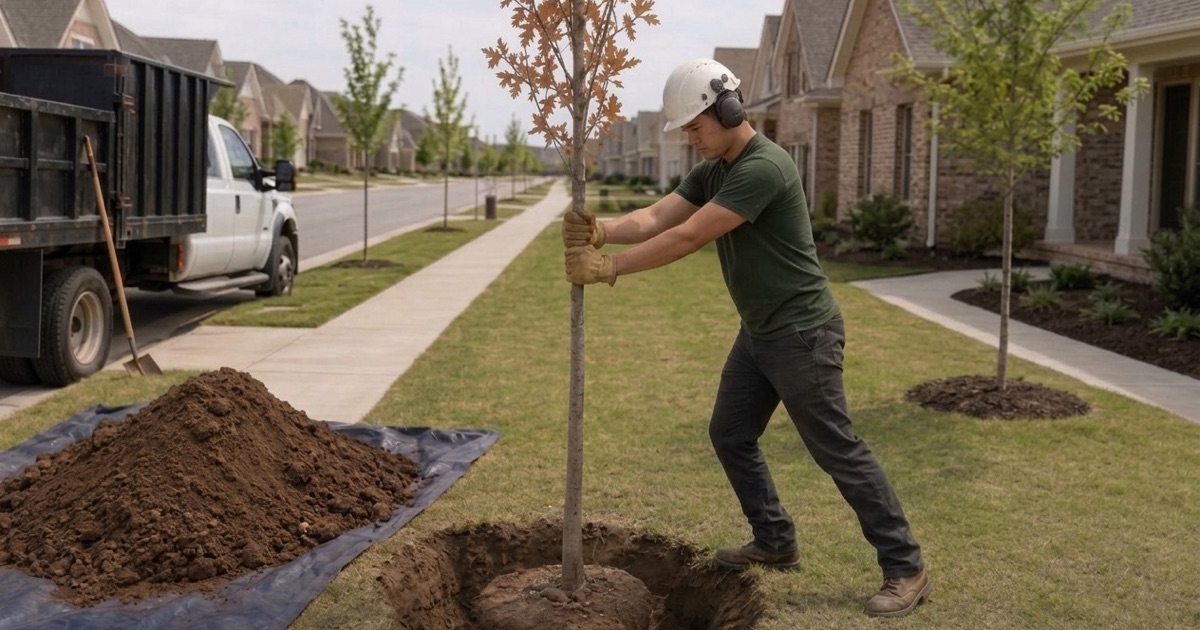
The flare goes in visible at the finished grade, every time. Container stock frequently arrives with the flare already buried under two or three inches of media, so it is located and exposed before the hole is dug rather than after. A tree set even slightly too deep spends its life with a wet collar, and the decline that follows is slow enough that nobody connects it to planting day.
The Hole, the Backfill and the Mulch Ring
The hole is dug wide and shallow rather than deep and narrow, with the sides broken up so roots are not turned back by a glazed wall. Backfill is the site soil, because a rich pocket in heavy ground behaves like a bucket. Mulch goes on as a ring with a clear gap around the trunk, never as a cone piled against the bark.
Watering Through the First Two Summers
Establishment on this ground takes two full growing seasons, and the failure mode is a few deep waterings replaced by frequent light ones that never reach the root ball. You get a written schedule with volumes and intervals rather than an instruction to keep it moist, because the difference between those two is most of the survival rate.
Transplanting an Established Tree
What Can Realistically Be Moved
Small and medium stock transplants dependably. As trunk diameter increases, the root ball that equipment can lift holds a steadily smaller share of the roots the tree has been living on, and at some point the move becomes a slow decline dressed up as a success. We give you that threshold honestly for the species and the site rather than quoting whatever was asked for.
Root Pruning Ahead of the Move
Where the schedule allows it, a tree worth moving is root pruned a season in advance so it can build fine roots inside the ball it will travel with. That single step does more for the odds than anything done on moving day. It requires planning ahead, which is why it is worth raising a move well before the ground is needed.
Aftercare and Being Honest About the Odds
A transplanted tree is a tree with a fraction of its root system in unfamiliar soil, so it gets the same establishment care as a new planting and then some, with reduced expectations for growth in the first two years. We say what the realistic odds are for the size and species involved, and where they are poor we recommend a new planting instead and say why.
- 20+ Years in Middle Tennessee
- Free Written Estimates
- ANSI A300 Pruning, No Topping